
What Is Natural Horn and How Is It Worked?
Natural horn is one of the oldest luxury materials in the world — used for centuries in cutlery, decorative objects, combs, and furniture components across Europe and Asia. Yet despite its long history, it remains poorly understood outside the circles of craftsmen and collectors who work with it directly. This article explains what natural horn is, where it comes from, how it behaves, and why working it requires a level of skill that takes years to develop.
What is natural horn?
Horn is a natural biological material that grows from the heads of certain animals — most commonly buffalo, ox, and cattle. It is composed primarily of keratin, the same protein found in human fingernails and hair, structured into dense overlapping layers that give the material its characteristic strength and flexibility.
Unlike bone or ivory, horn is a renewable material that grows continuously throughout the animal's life. The horns used in luxury craftsmanship are collected exclusively at the end of the animal's natural life cycle, as a byproduct of the food industry. No animal is sourced or harmed specifically for its horn.
Where does the horn used in luxury objects come from?
The two species most commonly used in fine horn craftsmanship are buffalo (Bubalus bubalis) and ox. Both are non-endangered species, widely present across Africa and the Indian subcontinent. At Zanchi 1952, we source raw horn directly from suppliers in Africa and India — a direct relationship with the material at source that we have developed and maintained over more than seventy years.
All horn used in our production is collected and traded in full compliance with the Washington Convention on International Trade in Endangered Species (CITES), which governs the international trade of animal-derived materials and prohibits the use of species at risk of extinction.
Horn processing waste from our workshop is returned to the soil as natural fertilizer — nothing is discarded.
What makes natural horn unique as a material?
The defining characteristic of natural horn — and the quality that makes it both exceptional and demanding to work with — is its complete unpredictability. No two pieces of horn are identical. Colours range from translucent blond to deep black, passing through every shade of amber, brown, and grey. The internal grain structure, visible when the material is thinned or polished, creates patterns that cannot be reproduced or imitated.
Horn also has a structural memory. If heated and bent into a new shape, it will hold that shape — but if not worked correctly, or if exposed to extreme heat, it will tend to return to its original curvature. This behaviour is what makes horn work technically demanding: the craftsman must understand not just how to shape the material, but how it will respond over time.
Finally, horn is hygroscopic — it responds to changes in humidity and temperature, expanding and contracting slightly with the environment. This is why horn objects should be kept away from extreme heat sources, dishwashers, and prolonged exposure to direct sunlight.
How is natural horn worked?
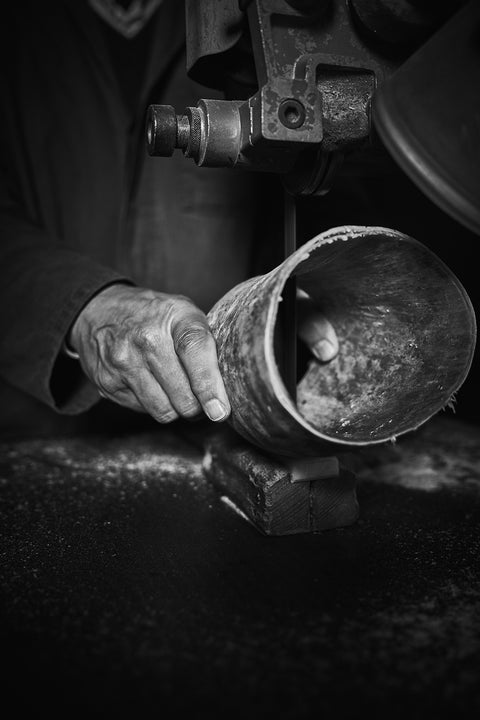
The transformation of raw horn into a finished luxury object involves a series of manual processes that have remained essentially unchanged for centuries. At Zanchi 1952, every stage takes place in our workshop in Bozzolo, Lombardy.
Selection. Raw horn arrives at our workshop in its natural state. The first step is individual selection — each piece is assessed for density, colour, internal grain, and overall quality. Horn that does not meet our standards is discarded at this stage.
Softening. Horn becomes workable when heated. Craftsmen use controlled heat — traditionally flame or hot water, depending on the application — to soften the material to the point where it can be shaped without cracking. The temperature and duration of heating must be judged by experience: too little and the horn will not move; too much and it will blister or discolour.
Shaping. Once softened, the horn is shaped manually using moulds, presses, and hand tools. For cutlery handles, the horn is cut to size, shaped around a form, and held under pressure until it cools and sets. For decorative objects, the process may involve multiple cycles of heating and shaping to achieve the desired form.
Cutting and finishing. Once shaped, the horn is cut, filed, and sanded through progressively finer grades — a process that may involve ten or more stages for a high-quality finish. The final polishing brings out the natural lustre of the material and reveals the internal grain in full.
Assembly. For objects that combine horn with other materials — such as cutlery with stainless steel, or desk accessories with silver-plated brass — the components are assembled and finished by hand at this stage.
How does natural horn age?
Well-maintained natural horn improves with age. The surface develops a patina — a subtle deepening of colour and lustre — that reflects the history of the object and the oils of the hands that have used it. This is a quality shared with other great natural materials: leather, wood, linen.
To maintain a horn object in optimal condition, wipe it with a slightly damp cloth and dry immediately. For objects that come into frequent contact with hands, an occasional treatment with a small amount of petroleum jelly or natural wax will keep the surface supple and prevent drying. Horn objects should never be placed in a dishwasher or left to soak in water.
Why choose natural horn over synthetic alternatives?
There are materials that imitate the appearance of horn — resins, plastics, and composites designed to replicate its colour and grain. None of them replicate its qualities. The weight, the warmth to the touch, the way it responds to light, the knowledge that no other object in the world is identical to the one you are holding: these are qualities that belong to the natural material alone.
At Zanchi 1952, we have worked exclusively with natural horn for over seventy years and four generations of the same family. It is not a material we use because it is fashionable or because it carries luxury associations. It is a material we use because, after all this time, we remain convinced that nothing else compares.
Explore our full collection of natural horn objects, or visit our Materials page to learn more about our sourcing approach.