
From Raw Horn to Finished Object: Inside the Zanchi 1952 Process
Long before a Zanchi 1952 piece reaches a table, a desk, or a collector's shelf, it begins as something unrecognisable: a raw, curved horn, still carrying the crust of the animal it came from. What happens between that raw state and the finished object is a process we have rarely described in public — eight stages, each done by hand, each passed from craftsman to craftsman since 1952. This is that process.
Where It Begins: Africa and India
Zanchi 1952 imports raw, unworked horn directly from Africa and India — buffalo and ox, always a byproduct of the food industry, never an animal sourced or harmed for its horn. It travels by sea, in containers: raw horn of animal origin cannot fly, and every shipment must clear the controls required for a material of this kind before it ever reaches our workshop in Bozzolo. Nothing about it, on arrival, looks like a finished object. It doesn't yet.
The Selection: An Eye Trained by Generations
Once in the workshop, specialised craftsmen sort every horn by hand — by size, by thickness, and by what we call its "mother colour": African horn is divided into blonde, veined pieces and black ones, while horn from India brings a wider range of shades again. But this first sorting is really only a guess. Raw horn arrives covered in an outer crust that hides its true colour completely, and horn itself is made of many layers, one beneath the other. Every stage of the process removes a little more of that crust — which means the real colour of a piece, the one you eventually see on your table, only reveals itself at the very last polish. Even after seventy years, we are occasionally still surprised by what a piece becomes.
The Cut
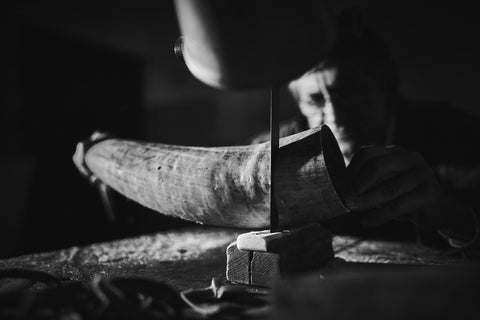
Before any heat is applied, the horn is cut. Each piece is sectioned according to the order at hand and the objects it will become: the tip is separated from the body, and the body itself is divided into sections by thickness. This is where a single horn stops being one shape and starts becoming many — the beginning of a cutlery set, a letter opener, or a set of napkin rings, decided at the very first cut.
The Heat: A Family Secret
What comes next is the part of the process we keep closest: a heat treatment, developed and refined within the family across generations, that we don't disclose outside the workshop. What we can say is what it makes possible — once the horn is split lengthwise, this technique allows it to be flattened into broad, even sheets. A material that started out curved, hollow and irregular becomes something workable: a flat slab of horn, ready to be cut into the shapes our collections are known for.
Shaping the Sheet
From that flattened sheet, the real shaping begins — and it changes depending on what the piece will become. The horn is calibrated to the exact thickness required, then cut to shape by milling or laser, and roughed out into its near-final form. This is the stage where a flat sheet of horn starts to look, unmistakably, like a handle, a tray, or the outline of a piece of cutlery.
Polishing: Patience Made Visible
Roughed-out pieces are still far from finished. Depending on the size and character of the object, polishing happens either through tumbling — letting the pieces smooth against each other over time — or entirely by hand, worked first against coarse grit wheels and then fine ones, until the surface takes on the depth and shine natural horn is known for. This is also the stage where the colour hidden since the very first selection finally appears in full.
When Horn Meets Metal
Some objects — cutlery, in particular — are not horn alone. Where a piece calls for it, our craftsmen assemble the finished horn components with other materials, typically stainless steel, joining the two by hand so the finished object is as sound structurally as it is beautiful.
The Final Inspection
Before anything leaves the workshop, every piece is inspected by hand for any crack or imperfection that may have surfaced during the process — horn is a natural material, and no two pieces behave identically under the same tools. Only once a piece passes this inspection does it move to packaging, ready to be shipped anywhere in the world.
Nothing Is Wasted
Horn is a material that lends itself naturally to reuse. Because we import whole, raw horn and section it ourselves according to what we are making, offcuts from one product often become the starting material for another. What remains after that is ground down and put back into other production within the workshop, rather than discarded. It is one more consequence of controlling the entire chain ourselves, from the raw material onward: very little is lost along the way.
Eight stages, one material, four generations of the same family — this is what stands between a raw horn from Africa or India and a finished Zanchi 1952 object. To see where that material comes from and how we source it responsibly, visit Materials & Sourcing. To read the family history behind this process, see About Us. If you are a designer, retailer, or brand exploring a collaboration, our Trade Program is the place to start.